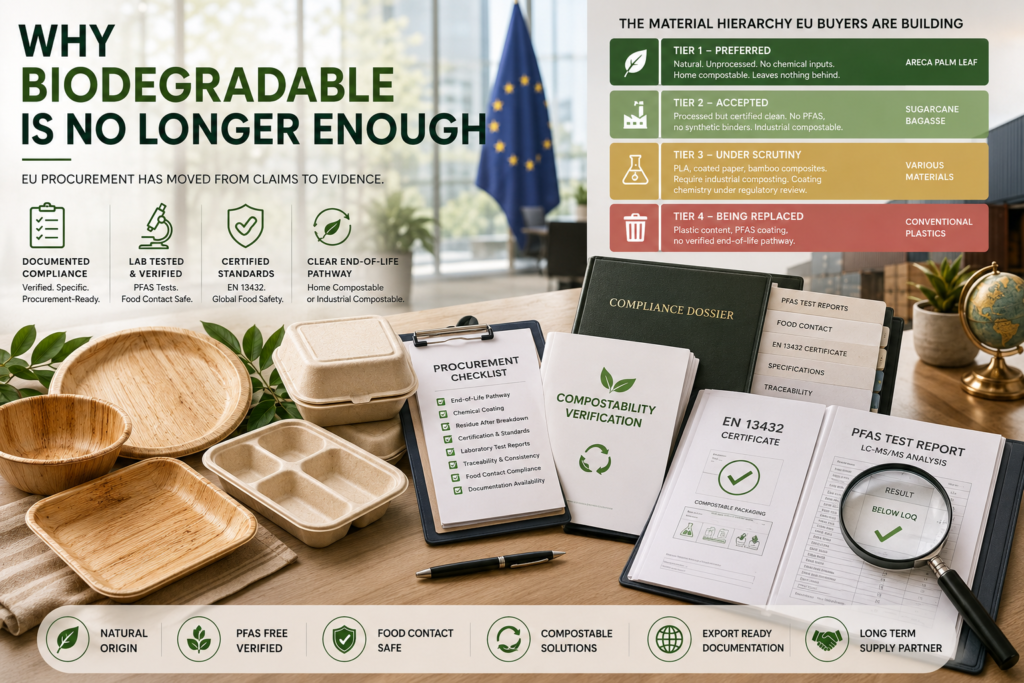
Why the Word “Biodegradable” Is Losing Procurement Value
The term biodegradable was once enough to attract buyer attention.
Today, it is often treated as a starting point rather than a decision-making factor.
The reason is simple.
Biodegradation without a timeframe has little practical meaning.
A material that breaks down in six months and a material that breaks down in five hundred years can both technically be described as biodegradable.
For procurement teams, that distinction matters.
Buyers increasingly want to know:
- How long decomposition takes
- What conditions are required
- Whether industrial infrastructure is necessary
- Whether any harmful residues remain
- Whether the claim has independent verification
As a result, purchasing decisions are moving away from marketing terminology and toward measurable performance criteria.
Why End-of-Life Pathways Matter
A sustainable packaging solution is only as effective as its disposal pathway.
This is becoming a central procurement consideration across Europe.
When buyers evaluate packaging, they increasingly assess what happens after use.
Questions include:
Can the material enter industrial composting systems?
Can it break down in home composting environments?
Does it require specialized collection infrastructure?
Is there a risk of contamination in waste streams?
Can the disposal pathway be clearly communicated to end users?
The answers influence not only compliance but also customer perception and operational practicality.
A product may appear sustainable at the point of purchase yet perform poorly at the point of disposal.
That gap is becoming increasingly important.
The Growing Importance of Material Transparency
European procurement teams are placing greater emphasis on material transparency than at any point in the past decade.
They want clarity regarding:
- Raw material origin
- Manufacturing inputs
- Additives and coatings
- Testing methodology
- Compliance documentation
- Traceability systems
The objective is not simply regulatory compliance.
The objective is risk reduction.
A transparent supply chain is easier to audit, easier to defend, and easier to explain to customers.
That transparency increasingly influences supplier selection decisions.
Why Documentation Has Become Part of the Product
Historically, packaging suppliers competed primarily on:
- Price
- Lead time
- Product quality
Today, a fourth factor has become equally important:
Documentation.
Many procurement teams now review compliance documentation before discussing commercial terms.
Typical evaluation files include:
- Food-contact declarations
- Compostability reports
- PFAS test reports
- Product specifications
- Laboratory certificates
- Manufacturing information
In practice, documentation has become part of the deliverable itself.
A supplier may offer an excellent product, but without supporting evidence, qualification becomes difficult.
What Importers Should Verify Before Approving a Supplier
Before onboarding any sustainable packaging supplier, buyers should review a structured checklist.
Material Composition
Understand exactly what the product contains and how it is produced.
Compostability Verification
Request evidence supporting compostability claims where relevant.
PFAS Verification
Confirm whether independent testing has been performed and review the report.
Food-Contact Compliance
Ensure documentation aligns with destination market requirements.
Product Traceability
Verify the ability to trace products back to production batches where applicable.
Documentation Availability
Assess how quickly and clearly supporting files can be provided.
The quality of the documentation process often reflects the quality of the supplier’s internal systems.
Why EU Buyers Are Moving Toward Natural Material Categories
Across multiple packaging applications, procurement teams increasingly favor materials that require fewer processing inputs.
The logic is straightforward.
Fewer processing stages generally mean:
- Greater transparency
- Reduced chemical complexity
- Simpler verification
- Easier compliance assessment
This helps explain growing interest in naturally derived packaging materials.
Buyers are not necessarily searching for the newest material.
They are searching for materials that are easier to understand, easier to document, and easier to qualify.
Procurement Is Becoming Evidence-Based
The broader sustainability conversation has matured significantly.
Five years ago, buyers often evaluated claims.
Today, buyers evaluate evidence.
A supplier statement may start a conversation.
A laboratory report advances it.
A complete compliance dossier closes it.
This shift is reshaping supplier qualification across food-contact packaging categories.
Companies capable of providing clear documentation, transparent testing, and traceable production systems are increasingly positioned ahead of competitors relying primarily on marketing claims.
The Future of Sustainable Packaging Procurement
The next phase of packaging procurement will likely focus less on environmental messaging and more on measurable outcomes.
Questions surrounding:
- Material transparency
- Chemical safety
- Compostability performance
- End-of-life pathways
- Regulatory alignment
- Supply chain traceability
will continue to influence purchasing decisions.
The direction is increasingly clear.
Sustainability claims alone are losing influence.
Verified sustainability performance is becoming the standard.
Final Thought
The most successful suppliers in the coming years will not be those making the boldest environmental claims.
They will be the suppliers capable of providing the clearest evidence.
For procurement teams, sustainability is no longer a marketing category.
It is a documentation category.
And in that environment, transparency, testing, and traceability become competitive advantages.d-contact aligned. PFAS verified.
Sunwhale Exports– Know about us