
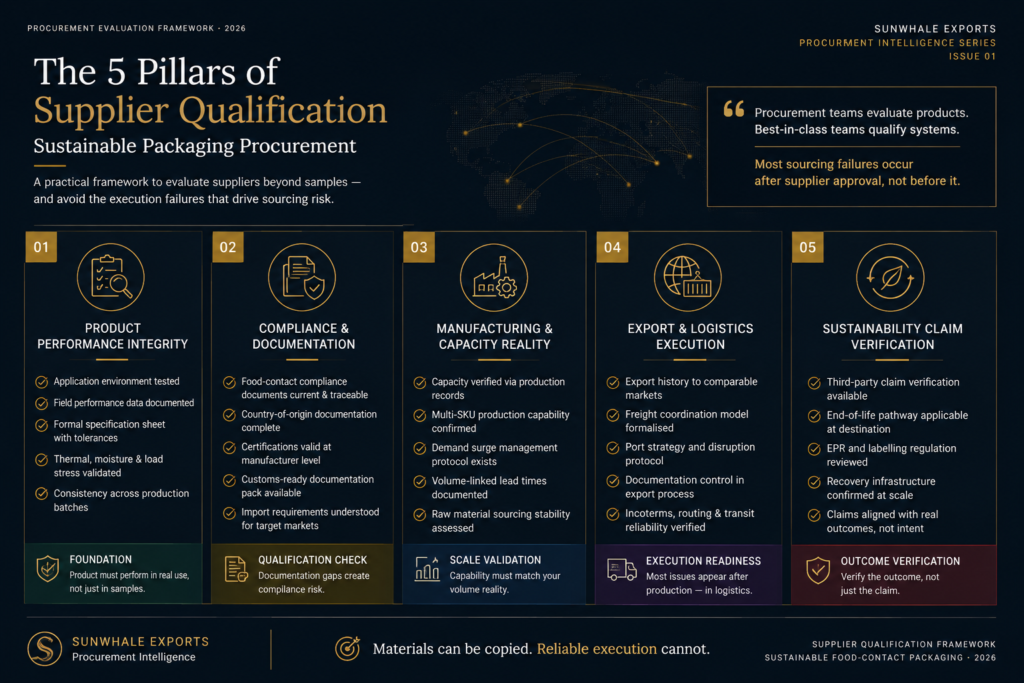
Sustainable Packaging Supplier Qualification: Most sustainable packaging sourcing failures are not material failures. They are supplier qualification failures.
Sustainable packaging procurement is no longer a material selection exercise.
It is a supplier qualification exercise.
A compostable package can still fail its sustainability objective. A certified supplier can still create import risk. A strong sample can still break down when moved into commercial-scale procurement.
In 2026, procurement teams are not only evaluating whether a product looks sustainable. They are evaluating whether the supplier can consistently deliver compliant, documented, commercially reliable packaging at scale.
That distinction matters.
The sustainable packaging market has expanded rapidly across areca palm leaf tableware, sugarcane bagasse packaging, moulded fibre formats, paper-based alternatives, and other natural fibre solutions. But the biggest procurement risk is not always the material.
The bigger risk is often the supplier behind it.
This article outlines a five-pillar supplier qualification framework for procurement teams sourcing sustainable food-contact packaging in 2026.
Executive Summary
The sustainable packaging category has moved from a niche sustainability initiative into a regulated, compliance-driven procurement domain.
Buyers now face documentation obligations, import requirements, food-contact compliance expectations, sustainability reporting pressure, and growing exposure under extended producer responsibility frameworks.
Yet many supplier evaluation processes remain too shallow.
A common approach still looks like this:
Check the product.
Check the certificate.
Check the price.
Place the order.
That approach is no longer enough.
In sustainable packaging, most procurement failures emerge after the purchase order is placed — during production, documentation, export coordination, customs clearance, claim verification, or commercial-scale execution.
The core argument is simple:
In 2026, supplier qualification is one of the most important sustainability decisions a procurement team can make.
The Procurement Shift in Sustainable Packaging
For most of the last decade, sustainable packaging procurement operated on a simple premise: find an alternative material, confirm certification, compare pricing, and move forward.
That model was always incomplete. It is now commercially risky.
Three structural shifts have changed the procurement equation.
1. Regulatory Pressure Has Become Documentation Pressure
Across the EU, GCC, UK, Saudi Arabia, India, and other major markets, packaging regulation is no longer just a policy direction.
It is an active procurement requirement.
Plastic restrictions, food-contact rules, labelling expectations, import documentation, and EPR-linked obligations all place new responsibility on the buyer.
A supplier may claim that a product is compliant. But procurement teams need to confirm whether the documentation is current, relevant, traceable, and applicable to the destination market.
The burden is no longer only on the supplier.
If documentation fails, the buyer faces the consequences.
2. Sustainability Claims Have Outpaced Verification
The market is saturated with claims such as:
Bio-based.
Compostable.
Recyclable.
Plastic-free.
Natural.
Eco-friendly.
Sustainable.
Some of these claims may be technically accurate. But technical accuracy does not always mean commercial validity.
A product certified as industrially compostable may not deliver a sustainable outcome in a market without industrial composting infrastructure.
A recyclable format may not be recovered if the destination market lacks collection and sorting systems.
A natural fibre product may still require proper documentation to support food-contact use, import clearance, and buyer-side due diligence.
In procurement terms, sustainability claims must be verified against the destination market, not only the product brochure.
3. Sourcing Failure Patterns Have Changed
The most common failures in sustainable packaging are not always product defects.
They are often supplier-side execution failures.
Common examples include:
Documentation gaps.
Capacity overclaims.
Unclear manufacturing responsibility.
Weak export coordination.
Poor lead-time control.
Customs documentation errors.
Unverified sustainability claims.
No escalation process when issues occur.
These risks are rarely visible during sample evaluation.
A sample shows what the product looks like.
A supplier qualification process shows whether the supplier can execute at scale.
The Five Supplier Qualification Pillars
A strong sustainable packaging supplier evaluation process should assess five areas.
Each pillar addresses a different risk.
Each pillar requires evidence — not verbal assurance.
Pillar 1: Product Performance Integrity
A compliant sample is only the starting point.
The real question is whether the product performs in the buyer’s actual operating environment.
Food-contact packaging is exposed to heat, moisture, oils, stacking pressure, storage conditions, transport vibration, and customer handling. A product that looks strong in a sample kit may behave differently in a live hospitality, airline catering, retail, or foodservice environment.
Procurement teams should evaluate whether the supplier has evidence of real performance, not only appearance.
Key Evaluation Questions
Has the product been tested in the intended application environment?
Are product specifications formally documented?
Is field performance validated across a meaningful commercial run?
What happens under heat, moisture, oil exposure, or extended storage?
Are tolerances, dimensions, grammage, strength, and packaging configuration clearly defined?
A supplier who answers these questions with data is operating with discipline.
A supplier who answers only with reassurance is asking the buyer to absorb the risk.
Pillar 2: Compliance and Documentation Architecture
Food-contact packaging is a documentation-governed category.
Every product crossing an international border carries documentation requirements. These may include food-contact declarations, country-of-origin documents, test reports, certification documents, shipment documents, and destination-specific compliance references.
The issue is not whether the supplier can show a certificate.
The issue is whether the documentation system is complete, current, traceable, and aligned with the actual manufacturing entity.
Key Evaluation Questions
Is food-contact documentation current and applicable to the destination market?
Are certifications valid and in scope?
Are certifications held by the manufacturer, not only an intermediary?
Is country-of-origin documentation complete?
Can the supplier provide a coherent documentation pack for customs, importer review, and buyer-side audit?
Does the documentation match the product, facility, and shipment structure?
Documentation failures are not minor administrative issues.
They can create customs delays, shipment holds, buyer disputes, rejected goods, and contract-level risk.
Pillar 3: Manufacturing and Capacity Reality
The gap between sample capability and commercial-scale execution is where many supplier relationships fail.
A supplier may be able to produce 500 good samples.
That does not automatically mean the supplier can support a 40-foot container programme across multiple SKUs, repeat orders, and strict delivery timelines.
Capacity must be verified, not assumed.
Key Evaluation Questions
Who actually manufactures the product?
What is the documented monthly capacity by SKU and format?
Can the supplier prove recent production volumes?
How does the supplier manage demand surges?
What is the lead-time model at commercial volume?
Are backup production lines or alternate qualified suppliers available?
How does the supplier manage quality control during scale-up?
The difference between “we can produce” and “we have produced” is critical.
Procurement teams should ask for evidence, not projections.
Pillar 4: Export and Logistics Execution Capability
Manufacturing capability and export capability are not the same.
A supplier may produce a strong product but lack export documentation control, freight coordination experience, port strategy, Incoterms understanding, or destination-market familiarity.
This is where many sustainable packaging sourcing programmes experience disruption.
The product may be ready.
The shipment may not be.
Key Evaluation Questions
Has the supplier exported to comparable markets before?
Which ports are used?
Is there a clear freight coordination model?
Who manages export documentation?
Does the supplier understand Incoterms operationally?
What happens under port congestion, documentation mismatch, shipment delay, or customs query?
Is there a structured communication flow between manufacturer, export partner, forwarder, and buyer?
Export execution is not a back-office detail.
It is a procurement risk-control function.
Pillar 5: Sustainability Claim Verification
This is where the gap between marketing language and procurement-grade evidence is often the widest.
A product may be bio-based.
It may be compostable.
It may be made from natural fibre.
It may reduce plastic dependency.
But procurement teams must ask a deeper question:
Does the sustainability claim hold in the destination market and commercial use case?
A claim that depends on unavailable recovery infrastructure is not a reliable sustainability outcome.
Key Evaluation Questions
What exact sustainability claim is being made?
What third-party evidence supports the claim?
Is the product home compostable, industrially compostable, recyclable, biodegradable, or simply bio-based?
Does the required end-of-life pathway exist in the destination market?
Is the claim valid under local labelling, import, or EPR rules?
Has the claim been reviewed for greenwashing exposure?
Sustainability claims must be practical, documented, and market-specific.
Otherwise, they remain theoretical.
Red Flags Procurement Teams Often Miss
Standard supplier evaluation processes often miss the warning signs that later become commercial problems.
Below are six red flags procurement teams should treat seriously.
1. The Certification Exists, but the Manufacturer Is Not Certified
A certificate held by a trading company, export house, or intermediary does not automatically cover the manufacturing facility.
For food-contact packaging, the manufacturing entity matters.
Always verify the factory name, location, certificate scope, validity, and product coverage.
2. Capacity Is Described, Not Documented
“We can produce 500,000 units per month” is not the same as “we produced 500,000 units last month.”
Procurement teams should ask for production records, shipment references, or capacity documentation.
Projected capacity is not the same as proven output.
3. Export History Is Limited to One Market
A supplier that has shipped to one country may have operational experience in that trade lane.
That does not mean it has mature export infrastructure.
Multi-market export execution requires documentation discipline, port familiarity, freight relationships, and regulatory understanding across different destination markets.
4. Sample Turnaround Is Much Faster Than Production Lead Time
If samples arrive in 72 hours but commercial production takes 45 days, procurement teams should investigate.
In some cases, samples may be sourced from inventory, third parties, or a different production setup.
The approved sample must match the commercial production source.
5. Sustainability Evidence Is Marketing-Led
If the supplier’s sustainability evidence is mainly brochure language, website copy, or generic claims, the risk is high.
Procurement-grade sustainability evidence should include test reports, certifications, declarations, lifecycle assessment summaries where relevant, and destination-market claim logic.
6. There Is No Clear Escalation Process
A mature supplier can explain what happens when something goes wrong.
Quality issue.
Shipment delay.
Documentation mismatch.
Customs query.
Production shortfall.
Buyer complaint.
If the supplier cannot describe escalation and recovery processes clearly, those processes likely do not exist.
Supplier Qualification Scorecard
Procurement teams can use the following scorecard to evaluate sustainable packaging suppliers across the five qualification pillars.
Score each criterion from 1 to 5.
Recommended minimum threshold for commercial engagement:
Average score: 3.5 or above
No individual pillar below 3.0
Supplier Qualification Scorecard
| Pillar | Evaluation Criterion | Max Score |
|---|---|---|
| Product Performance | Application testing documented | 5 |
| Product Performance | Field performance data available | 5 |
| Product Performance | Formal specification sheet with tolerances | 5 |
| Compliance & Documentation | Food-contact documentation current and traceable | 5 |
| Compliance & Documentation | Country-of-origin documentation complete | 5 |
| Compliance & Documentation | Certifications held at manufacturer level | 5 |
| Manufacturing & Capacity | Capacity verified through records | 5 |
| Manufacturing & Capacity | Multi-SKU production capability | 5 |
| Manufacturing & Capacity | Demand surge management protocol exists | 5 |
| Export & Logistics | Documented export history to comparable markets | 5 |
| Export & Logistics | Freight coordination model formalised | 5 |
| Export & Logistics | Port strategy and documentation control in place | 5 |
| Sustainability Claims | Third-party claim verification available | 5 |
| Sustainability Claims | End-of-life pathway applicable in destination market | 5 |
| Sustainability Claims | EPR and labelling regulation reviewed | 5 |
| Total | 75 |
Score Interpretation
| Score Range | Interpretation | Procurement Action |
|---|---|---|
| 60–75 | Strong qualification | Proceed to commercial terms |
| 45–59 | Conditional qualification | Identify and close gaps before commitment |
| 30–44 | High risk | Do not proceed without mitigation |
| Below 30 | Not recommended | Avoid commercial engagement |
A scorecard does not replace judgement.
But it helps procurement teams move supplier evaluation from subjective confidence to documented comparison.
Frequently Asked Questions
How does this framework apply to suppliers in India, Vietnam, Bangladesh, or other emerging markets?
The framework applies universally.
However, emerging market suppliers should be evaluated with extra care around export documentation, destination-market compliance, and shipment execution capability.
Many suppliers may have strong manufacturing capability but limited export documentation infrastructure. Procurement teams should assess manufacturing and export readiness separately.
A strong factory is not always a strong exporter.
How should procurement teams handle suppliers with strong certifications but limited export history?
This is common in sustainable packaging.
Strong certifications may support product compliance, but they do not prove export execution capability.
Procurement teams should either conduct deeper export readiness due diligence or work through a qualified export partner that can coordinate documentation, supplier qualification, shipment execution, and destination-market alignment.
At what volume should full supplier qualification be conducted?
Full qualification is recommended for any strategic supplier relationship, even if the first order is small.
A supplier engaged for a low-volume pilot today may be expected to support recurring commercial orders within twelve months.
Qualification gaps that look manageable at low volume can become serious procurement risks at scale.
How often should supplier qualification be reviewed?
Supplier qualification should be reviewed at least annually.
It should also be reviewed when any of the following occur:
Regulatory change in the destination market.
Change in manufacturing facility or ownership.
New product format or material grade.
Major capacity expansion.
Repeated shipment issues.
New sustainability or compliance claim.
Supplier qualification is not a one-time approval.
It is an ongoing procurement control process.
What is the difference between a manufacturer’s certification and a trading company’s certification?
A manufacturer’s certification applies to the manufacturing facility and its approved scope.
A trading company’s certification applies to that trading entity.
For food-contact packaging, procurement teams must verify that the actual manufacturing facility holds the relevant certification or documentation required for the product and destination market.
This distinction is critical.
A certificate presented by an intermediary does not automatically validate the product’s manufacturing source.
Conclusion
The sustainable packaging materials landscape is crowded.
Areca palm leaf, sugarcane bagasse, moulded fibre, paper-based formats, PHA-based materials, and other natural fibre alternatives are all commercially available.
But material availability does not guarantee procurement reliability.
The difference between a successful sustainable packaging programme and a failed one is often the supplier qualification discipline that comes before the purchase order.
In 2026, procurement teams must evaluate more than product appearance, certification claims, and price.
They must evaluate whether the supplier can deliver compliant, documented, scalable, and commercially reliable outcomes across the full execution chain.
The better question is no longer:
“Is this packaging sustainable?”
The better question is:
“Can this supplier consistently deliver sustainable outcomes at commercial scale, with documentation that holds?”
That is where procurement discipline separates from procurement process.
And in sustainable packaging, that distinction matters.
About Sunwhale Exports
Sunwhale Exports is an India-based structured export partner and sourcing platform focused on sustainable food-contact packaging for international markets.
Sunwhale supports buyer-led sourcing, supplier qualification, documentation coordination, private label execution support, and shipment execution across natural fibre packaging categories including areca palm leaf tableware and sugarcane bagasse moulded fibre packaging.
Sunwhale works with international buyers seeking procurement-aligned sourcing support from India — with emphasis on supplier verification, documentation discipline, and export execution readiness.
Need to Evaluate Sustainable Packaging Suppliers from India?
Sunwhale Exports supports international procurement teams with supplier qualification, documentation coordination, private label execution support, and shipment-ready sourcing from India.
Contact: sales@sunwhaleexports.com
Website: www.sunwhaleexports.com