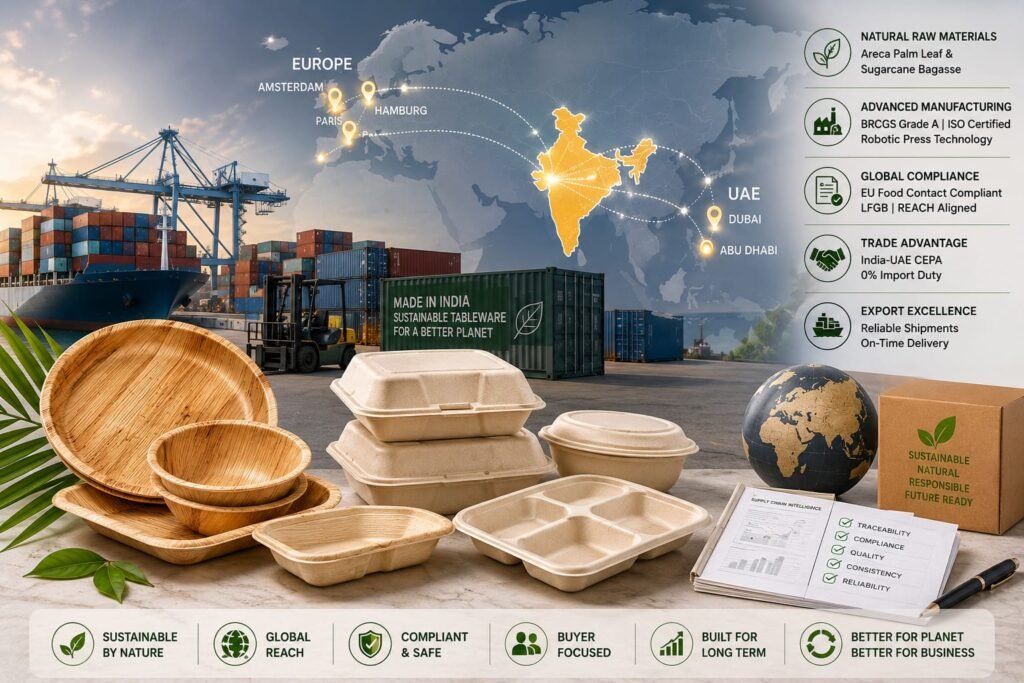
Why India Is Winning the Sustainable Tableware Race: The Real Advantage Is Not Labour Cost. It Is Supply Chain Control.
Many buyers still assume India’s advantage comes primarily from lower manufacturing costs.
That perception is outdated.
The stronger advantage is supply chain control.
For sustainable tableware categories such as areca palm leaf and bagasse, the raw material source is local to the manufacturing ecosystem.
The agricultural origin, primary processing, conversion, packaging, and export preparation can all occur within the same country.
This reduces dependency on complex international raw-material supply chains.
For importers, that translates into:
- Greater sourcing visibility
- Shorter procurement cycles
- Reduced supply chain disruption risk
- Improved forecasting reliability
- Better traceability documentation
When supply chains become more transparent, procurement becomes easier to manage.
Why Procurement Teams Are Prioritising Traceability
Five years ago, many buyers focused primarily on pricing.
Today, procurement conversations increasingly begin with documentation.
Questions now commonly include:
- Where does the raw material originate?
- Which facility produced the product?
- What compliance documentation is available?
- Can the production batch be traced?
- What testing supports product claims?
Importers are expected to answer these questions internally and externally.
Retail customers ask.
Regulators ask.
Sustainability teams ask.
The ability to provide traceable information is becoming part of supplier competitiveness.
The Rise of Procurement-Led Sustainability
Sustainability initiatives were once driven primarily by marketing departments.
That is no longer the case.
Today, procurement teams increasingly influence sustainability outcomes because they determine which suppliers enter the supply chain.
The conversation has evolved from:
“We need sustainable packaging.”
to
“We need sustainable packaging that can pass procurement review.”
That distinction matters.
Products alone do not create compliant supply chains.
Supplier systems do.
Documentation does.
Verification does.
Execution does.
Why Buyer Expectations Have Increased
Global buyers have become significantly more sophisticated.
Many have already experienced:
- Shipment delays
- Documentation gaps
- Compliance failures
- Product inconsistency
- Communication breakdowns
As a result, qualification standards have increased.
Importers increasingly expect suppliers to provide:
Clear Documentation
Specifications should be organised, current, and easily accessible.
Responsive Communication
Questions should be answered quickly and accurately.
Consistent Product Quality
Repeat orders should match approved samples.
Structured Commercial Processes
Pricing, lead times, packaging specifications, and shipment details should be documented clearly.
The supplier relationship increasingly resembles a procurement partnership rather than a simple transaction.
Why Areca and Bagasse Continue to Gain Attention
Although the broader sustainable packaging sector contains numerous material categories, areca and bagasse continue to attract procurement interest because they solve different operational requirements.
Areca Palm Leaf
Often selected where presentation matters.
Common applications include:
- Hospitality
- Premium catering
- Outdoor events
- Corporate dining
- Resort operations
The natural appearance provides differentiation that many buyers value.
Bagasse
Often selected where scalability matters.
Common applications include:
- QSR chains
- Food delivery
- Institutional catering
- Airline catering
- Retail food packaging
The range of available formats supports high-volume operational environments.
For many procurement teams, the categories complement rather than compete with each other.
What UAE Buyers Are Doing Differently
The UAE market has become increasingly procurement-driven.
Buyers are evaluating suppliers not only on product characteristics but also on commercial readiness.
Key considerations often include:
- UAE import experience
- Documentation availability
- Private label capability
- Lead-time reliability
- Multi-SKU shipment capability
- Long-term supply continuity
The introduction of CEPA strengthened India’s position, but procurement decisions continue to depend on execution capability.
Trade agreements create opportunity.
Operational performance converts opportunity into repeat business.
What EU Buyers Are Doing Differently
European buyers are placing increasing emphasis on:
- Product compliance
- Supplier transparency
- Risk management
- Traceability
- Documentation quality
Many importers now perform supplier qualification reviews before commercial discussions advance.
This means suppliers are evaluated not only on what they manufacture but also on how they operate.
Documentation has become part of the product.
The Competitive Advantage of Repeatability
Most procurement managers are not searching for a supplier that performs well once.
They are searching for a supplier that performs consistently over multiple purchase orders.
Repeatability creates value because it reduces:
- Internal workload
- Procurement risk
- Inventory uncertainty
- Compliance concerns
- Supplier management complexity
The strongest supply chains are built on predictable execution rather than exceptional one-time performance.
Looking Ahead: The Next Five Years
The structural drivers supporting India-origin sustainable tableware remain in place.
Agricultural raw-material availability continues.
Manufacturing capability continues to expand.
Export infrastructure continues to improve.
Trade relationships continue to strengthen.
At the same time, buyer expectations around compliance, documentation, and supply-chain visibility will continue to increase.
The winners will not necessarily be the suppliers with the lowest prices.
They will be the suppliers capable of combining:
- Manufacturing capability
- Compliance readiness
- Documentation discipline
- Communication quality
- Long-term procurement alignment
That combination is increasingly becoming the standard requirement for international buyer programmes.
Conclusion
The sustainable tableware market is no longer defined solely by manufacturing capacity.
It is increasingly defined by supply-chain reliability.
India’s advantage extends beyond raw materials and production capability. The country now offers the agricultural foundation, manufacturing ecosystem, export infrastructure, and trade-policy positioning required to support long-term procurement programmes across UAE, Europe, and other international markets.
For buyers, the strategic question is no longer whether India belongs in the sourcing portfolio.
The question is which India-origin supply chain can deliver the consistency, documentation, and accountability required for the next decade of procurement.
Sunwhale Exports — India-origin areca and bagasse tableware. CEPA-eligible for UAE. EU food-contact compliant. Structured for long-term buyer programmes.